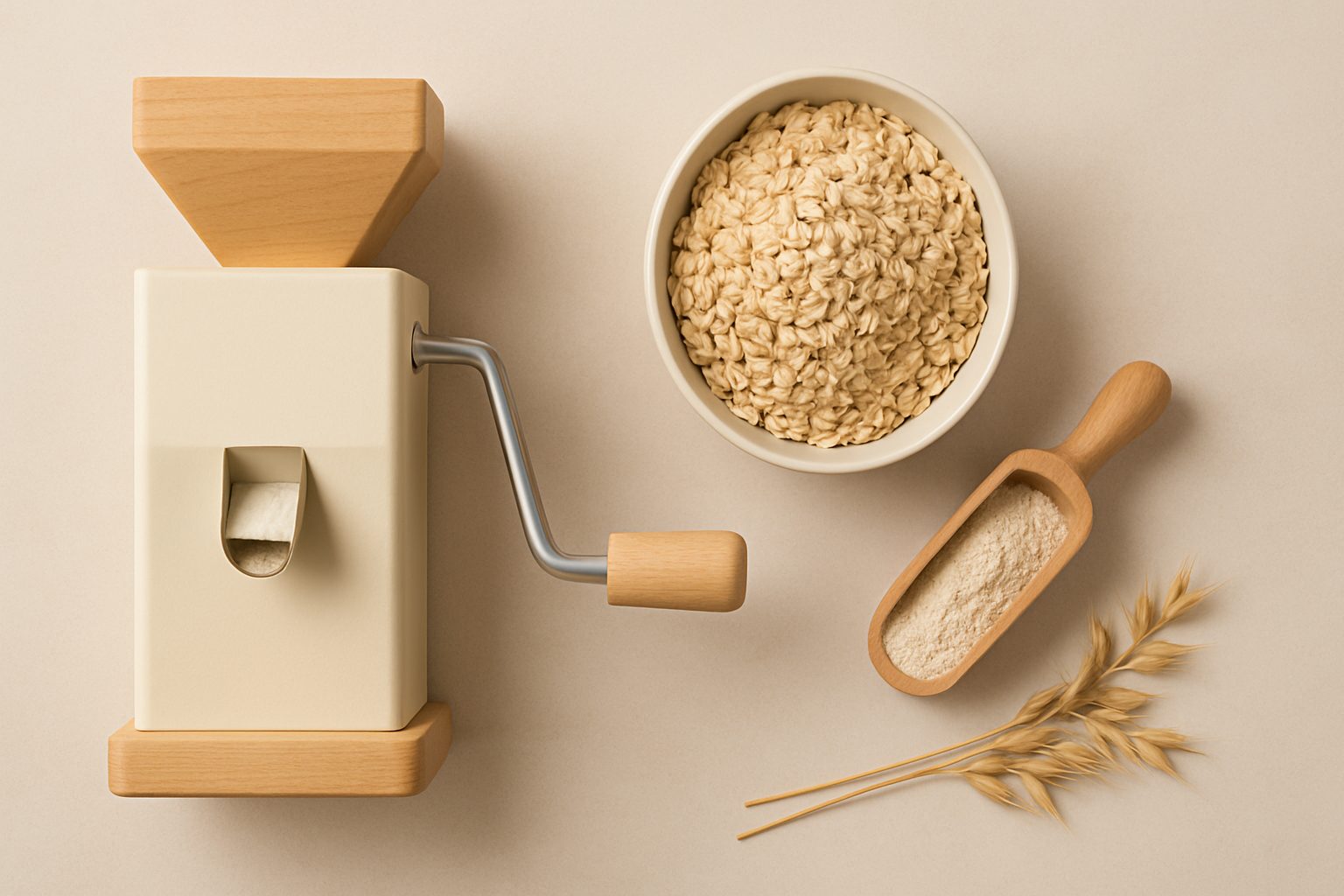
What Is a Home Grain Roller and How Does It Work?
A home grain roller is a mechanical device that crushes grain into a coarse, inconsistent flour—without pulverising it into dust. Unlike a flour mill, which produces fine powder, a grain roller flattens whole grain kernels between two rotating rollers, cracking the husk and breaking apart the endosperm while leaving the germ largely intact. For home brewers, smallholders, and sourdough bakers, this matters a lot.
If you've ever tried grinding grain for brewing or baking at home, you'll know that a food processor or blender either leaves chunks untouched or turns everything to powder with nowhere in between. A grain roller sits in that middle ground—and it's become increasingly popular among UK home brewers and small-scale milling enthusiasts over the past decade.
What Is a Home Grain Roller?
A home grain roller is a tabletop or bench-mounted mill with two corrugated steel or composite rollers that rotate towards each other. You feed whole grain (barley, wheat, oats, rye, maize) in from the top, it drops between the rollers, gets crushed as they turn, and emerges as a gritty, flaked meal at the bottom. The whole process takes seconds per handful.
The term "grain roller" is sometimes used interchangeably with "two-roller mill," but the distinction matters: some rollers are corrugated (rougher surface for grip), whilst others are smooth. Most home models use corrugation because it prevents grain from slipping through without being crushed.
Unlike hammer mills (which use high-speed impact) or stone mills (which generate heat and friction), roller mills work through compression and shearing. This gentler approach means less heat damage to the grain, which is why brewers prefer them—heat damages enzymes needed for mashing.
How the Roller Mechanism Works
Inside a grain roller, two heavy steel cylinders sit parallel to each other, usually between 30 and 75 mm in diameter depending on the model. They're driven by an electric motor (almost all home models are electric), which turns both rollers at the same speed in opposite directions—one clockwise, one anticlockwise. This opposing rotation pulls grain through the gap between them.
The rollers themselves are slightly offset or have a wedge-shaped gap: wider at the input end, narrower at the output end. As grain tumbles down, it encounters increasingly tight compression. The corrugated (or sometimes fluted) surface of the rollers grips the grain and applies shearing force, cracking the husk and splitting the kernel without grinding it to meal.
Most home models are single-pass mills: grain goes in once, gets flaked, and comes out. Some commercial or semi-commercial designs can take flaked grain back through for finer reduction, but home units typically aren't designed for that.
The mechanics are straightforward by design. Fewer moving parts than a stone mill, less maintenance than a hammer mill. A basic model can weigh 15–30 kg and fit on a kitchen bench, though brewery-scale units are heavier and more robust.
Understanding Gap Adjustment
The gap between the rollers is the critical control. Most home grain rollers have a simple adjustment mechanism—usually a hand wheel or threaded rod on one side—that lets you move one roller closer to or further from the other. This changes how coarse or fine the output is.
Coarse gap (1.5–2 mm): Grain emerges as large flakes. Useful for brewing, where you want to preserve grain structure so the starches can convert during mashing, but avoid flour that would create a stuck mash. Also good if you're grinding mixed grain for animal feed and don't need uniformity.
Medium gap (1–1.5 mm): The most common setting for home brewers. Balances crack size with consistency. Gives you flaked grain, a few flour fines, and minimal whole kernels.
Fine gap (0.5–1 mm): Produces more flour and fewer large flakes. Better for baking bread or sourdough, where you want more surface area and faster hydration, though you'll still get some texture rather than talc-fine flour.
Gap adjustment is usually marked with notches or numbers so you can return to a setting you like. Some newer models have digital readouts, but mechanical adjustment is more common and just as effective.
Grain Types and Roller Compatibility
Home grain rollers handle most common grains:
- Barley: The standard for home brewing. Soft enough that rollers crush it easily, and the hull is naturally papery—it won't powder.
- Wheat: Slightly harder than barley but still manageable. Can produce more flour fines, so many brewers use a slightly coarser gap.
- Oats: The hull is thicker and tougher. Some rollers struggle; confirm compatibility before buying if oats are your target.
- Rye: Dense and compact. Requires a gap adjustment and sometimes slows the feed rate, but works fine.
- Maize: Hard and dense. Only suitable for mills with sufficient torque; lighter hobby models may stall or bind.
Not all home rollers are equal. Cheap models with lightweight motors can choke on dense grain; you'll see the motor bog down, the sound change, sometimes the rollers slow. Quality matters here. A mid-range mill with a proper motor will cruise through barley at a sensible feed rate. Budget models often require you to feed grain slowly, one handful at a time, which defeats the point.
One genuine limitation: moisture content. If grain is too wet (above 12–13% moisture), rollers will gum up and stick. Grain should be dry-stored. This isn't a flaw in the design—it's how all dry mills work.
Why Home Brewers and Smallholders Use Grain Rollers
For small-batch home brewing, a roller is faster and cheaper than buying pre-milled grain repeatedly. For smallholders mixing feed, a roller lets you crack whole grain rather than buying expensive cracked stock. For bakers experimenting with freshly milled flour, a roller produces grain flour that's fresher and textured in a way commercial mills don't.
The appeal is practical: they're durable, unfussy, and do one job well. No filters to clean, no fine powder everywhere, minimal electricity draw.
---
For buying decisions, explore our grain roller buying guide to find models suited to UK home brewers, or compare popular options in our grain roller comparison article.
More options
- Electric Home Grain Flaker / Roller (Amazon UK)
- Manual Grain Roller for Home Use (Amazon UK)
- KitchenAid / Stand Mixer Grain Roller Attachment (Amazon UK)
- Eschenfelder Grain Flaker (Amazon UK)
- Whole Grain Oats & Wheat Berries (consumable upsell) (Amazon UK)