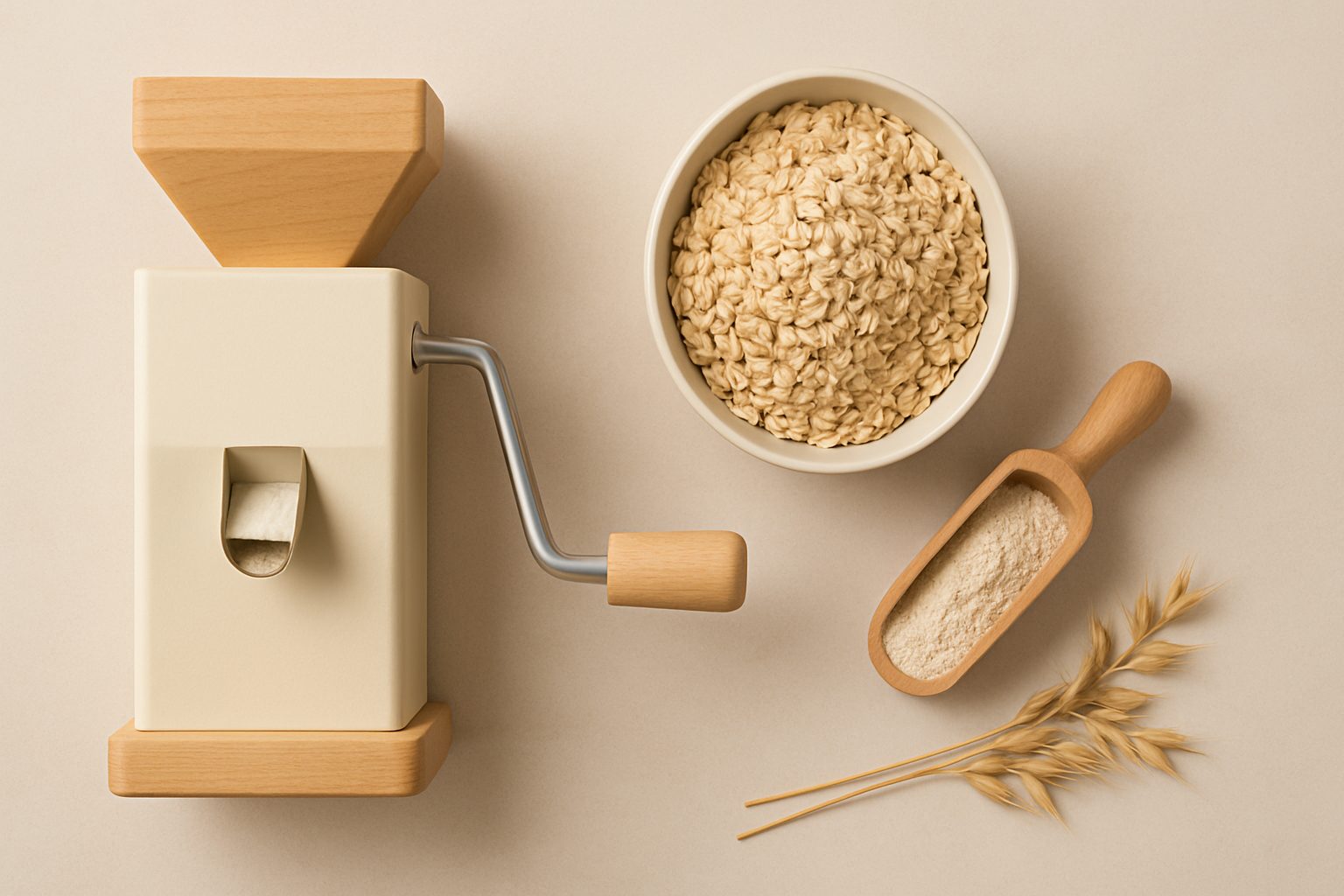
How to Choose the Right Roller Gap Setting for Different Grains
If you're new to home grain rolling, the gap between your mill's rollers might seem like a minor detail. It isn't. The distance you set between those rollers fundamentally changes how your grain breaks down, which affects flour particle size, brewing efficiency, milling speed, and the final quality of your flour or malt. Getting it right for each grain type makes the difference between a roller that works well and one that frustrates you.
Why Gap Setting Matters
Grain rollers work by crushing kernels between two counter-rotating cylinders. The space between them—measured in millimetres—determines the size of the flakes or flour fragments you end up with. Too tight, and the rollers jam or work too slowly. Too loose, and you get uneven crushing, with some kernels barely cracked and others pulverised into dust.
The gap you choose depends on:
- Grain type and hardness – malted barley needs a different setting than oat groats
- Your intended use – brewing requires different flake sizes than bread-making flour
- Roller design – smooth rollers versus fluted rollers behave differently at the same gap
- Feed rate – how fast you're pushing grain through affects optimal spacing
For homebrewers and small-scale millers, nailing these settings means better extraction, fewer re-runs, and grain that mills smoothly without binding.
Gap Settings for Common Grains
Oats
Oat kernels are relatively soft and have a papery husk. Most home rollers handle them well at a 0.8–1.2 mm gap.
At the tighter end (0.8 mm), you'll get finer oatmeal suitable for baking or porridge. The rollers compress the kernel evenly and the husks crack without shattering into too many small fragments. Go tighter than 0.8 mm and you risk the husks turning to dust, which some people prefer for texture but others find unpleasant.
At 1.2 mm, oats roll into flatter flakes with more visible husk fragments. This works well if you're using them for brewing or want a coarser texture for muesli-style mixes. The trade-off is less flour dust, which some prefer.
Wheat
Wheat berries are harder and denser than oats, so they need a slightly tighter setting: 0.6–1.0 mm.
At 0.6 mm, you get a finer, more uniform break. This is worth using if you're milling for bread flour or want maximum extraction in brewing. The downside is that the rollers work harder—you'll mill more slowly and put more strain on the motor, especially if you're running a budget model with a small drive.
At 0.8–1.0 mm, wheat breaks into larger, more irregular flakes. This is gentler on equipment and works reasonably well for many brewing applications. You'll lose some fine flour, but the milling speed is faster and the load on the rollers is lighter.
Wheat varies by variety—soft white wheat is slightly more forgiving than hard red winter wheat—but start in this range and adjust based on how the flour looks coming out.
Barley and Malted Grains
Malted barley is the grain most home brewers mill regularly. The malting process softens the kernel and loosens the husk, so you can mill at a 1.0–1.4 mm gap and still achieve excellent husk separation and good extraction.
Many brewers favour 1.2 mm as a sweet spot: it cracks the kernel thoroughly without pulverising it, keeps husk fragments reasonably intact (which helps with lautering), and doesn't strain a modest-sized mill. At this setting, a single pass usually gives you properly crushed grain with acceptable flour content.
Tighter than 1.0 mm and you risk producing too much flour and dust—useful if you want maximum extraction, but the husks often break into pieces fine enough to pass through your lauter tun. Looser than 1.4 mm and some kernels won't crack properly, which means lower efficiency.
Non-malted barley (used occasionally in specialty brewing) is harder and benefits from the tighter end of the wheat range: around 0.7–0.9 mm.
Rye
Rye kernels are comparable in hardness to wheat but have a slightly more brittle husk. A 0.7–1.1 mm gap works well.
Rye flour tends to get sticky if it's milled too finely, so many home bakers and brewers prefer it at the looser end: 1.0–1.1 mm. This produces flakes rather than powder, which is less likely to clump. If you're using rye for bread and want a finer flour, 0.7–0.8 mm is possible, but be prepared for the mill to work harder and produce a flour that needs careful handling during mixing.
The Case for Micrometric Gap Adjustment
Budget grain rollers often have a single fixed gap, or adjustment via a crude screw mechanism. You loosen, adjust by eye, tighten, run a test batch, and repeat if it's wrong. It's tedious and rarely precise.
Premium models with micrometric adjustment feature a calibrated dial or fine-threaded adjuster that lets you change the gap in 0.05 or 0.1 mm increments. The difference is immediate and visible: you can dial in exactly the gap you want, switch between grains without guesswork, and reproduce settings week to week.
If you mill multiple grain types regularly—or if you're particular about flour consistency—this feature pays for itself in time saved and better results. The precision also extends the life of your rollers because you're not forcing them tight or running them dangerously loose.
How to Test Your Settings
Once you've set a gap, run a small handful of grain through and examine the output. You want:
- Even crushing – most kernels broken, few whole pieces
- Appropriate particle size – finer for flour applications, coarser for brewing
- Husk integrity (for malted grains) – husks broken but not powdered
- No jamming or binding – the grain flows smoothly without stalling the rollers
If the grain is stalling, open the gap up by 0.2 mm. If too much passes through uncrushed, tighten by 0.1–0.2 mm. Most home roller users dial in their preferred settings within a few test runs.
Getting Started
Start with the middle of the recommended range for your grain type—1.0 mm for wheat, 1.2 mm for malted barley—and adjust from there based on what your roller produces. Keep notes of settings that work well. Grain varies by crop and moisture, so you may find yourself tweaking by 0.1–0.2 mm between batches, but a good starting point saves time.
If you're regularly milling different grains, investing in a roller with precise gap adjustment will make the process less fiddly and your results more consistent.
More options
- Electric Home Grain Flaker / Roller (Amazon UK)
- Manual Grain Roller for Home Use (Amazon UK)
- KitchenAid / Stand Mixer Grain Roller Attachment (Amazon UK)
- Eschenfelder Grain Flaker (Amazon UK)
- Whole Grain Oats & Wheat Berries (consumable upsell) (Amazon UK)