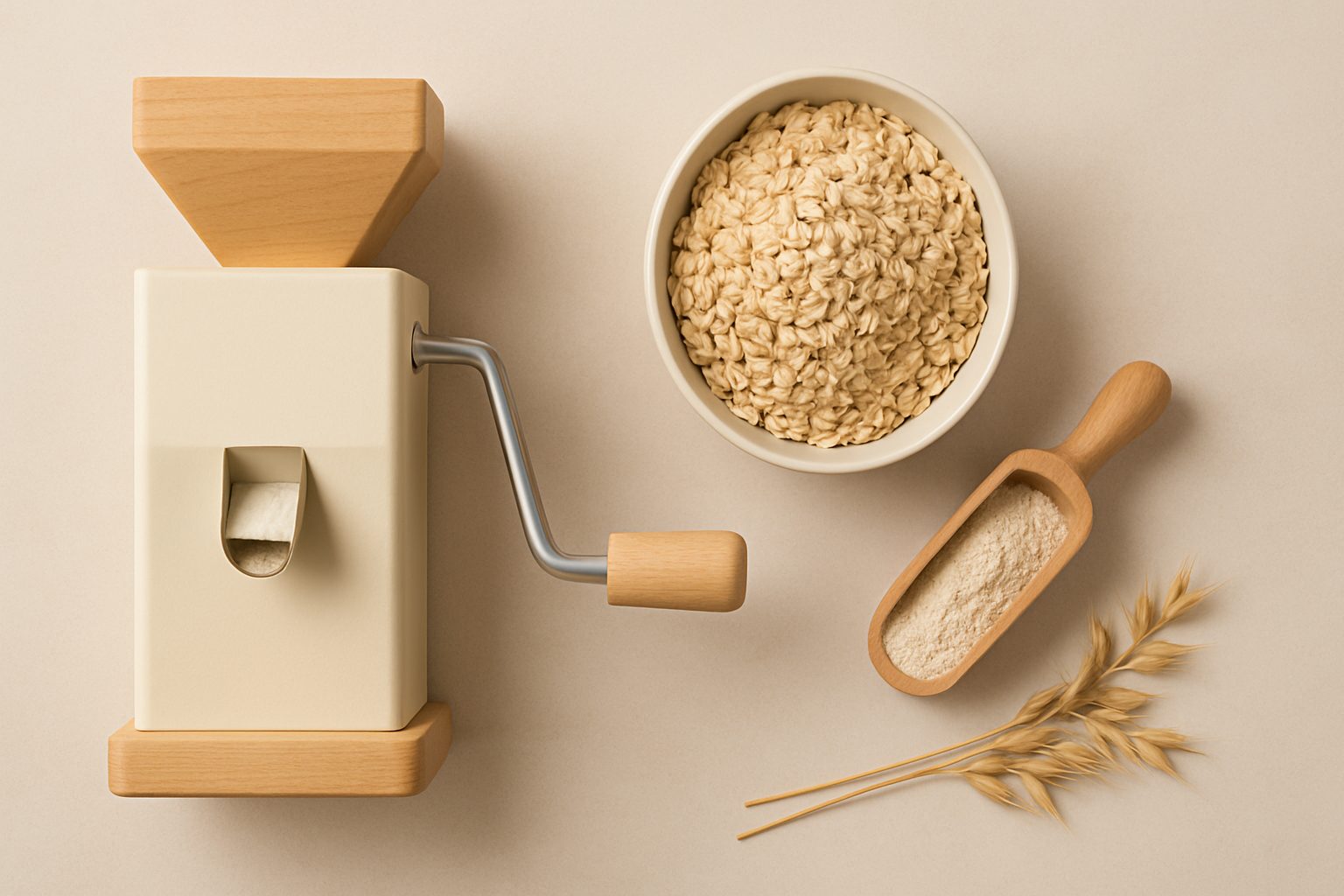
How to Use a Grain Roller for Sourdough Baking: A UK Baker's Guide
If you're a sourdough baker working with whole grains, a grain roller isn't just a nice addition to your setup—it changes how your dough behaves and how your loaf tastes. Unlike store-bought flour, freshly rolled grain is coarser, fluffier, and absorbs water differently. Get that wrong and your dough either becomes soup or stays stiff. Get it right and you unlock flavour and texture that bagged flour can't match.
This guide walks you through what a grain roller actually does, how to use one properly with sourdough, and which models give you the precision you need.
Why sourdough demands fresh-milled flour
Freshly milled flour is dramatically different from what's been sitting in a bag for months. When you mill grain at home, the bran particles are sharp and intact. The endosperm hasn't oxidised. The germ hasn't started to go rancid. All of this matters for sourdough.
Fresh-milled flour absorbs water much more readily than aged flour. A dough hydration that works beautifully with supermarket bread flour—say 75%—can feel loose and sticky with fresh whole grain flour. You'll often need to drop to 70% hydration or even lower, depending on how coarse your roll is. The water sits on the surface of those jagged bran particles rather than being absorbed instantly.
Flavour is more immediate too. The volatile compounds in fresh grain haven't had time to fade. Your sourdough develops nuttier, more complex flavours faster, and the tang from your starter interacts with the grain oils in ways bagged flour doesn't support.
How grain gap setting changes your result
The gap setting on your roller determines particle size. This is not a subtle variable—it shapes your dough's behaviour and your loaf's final crumb.
A coarse setting (2.5–3.5 mm) produces flour that's genuinely coarse: visible flakes, especially noticeable in whole-grain loaves. This flour absorbs water slowly and irregularly. You'll need longer autolyse times, often 45–60 minutes, to fully hydrate. The upside is that coarse flour tends to ferment more slowly, giving you better control over bulk fermentation timing. It also produces a more distinct, open crumb with visible grain particles.
A medium setting (1.5–2 mm) is where most sourdough bakers end up. Particles are small enough to distribute evenly but large enough that you see real grain texture in the loaf. This setting works with hydrations around 72–76%, close to what you'd use with commercial whole-meal flour. Fermentation is predictable and dough handling is straightforward.
A fine setting (under 1 mm) produces flour nearly indistinguishable from what you'd buy bagged. You can use standard sourdough hydrations. If you're mostly baking white bread with occasional sourdough, you might roll fine. But you lose that distinctive fresh-grain character, which defeats the purpose of rolling your own.
Start with a medium setting if this is your first time. You can adjust once you understand how your dough feels.
Step-by-step: using a grain roller with sourdough
1. Measure grain by weight, not volume. Use 500 g of grain to start. This gives you roughly 400 g of finished flour, accounting for bran loss.
2. Clean the grain first. Tip it into a fine sieve, shake gently to remove dust and broken bits, rinse if you've stored it loose. Dry grain rolls much more consistently than damp grain.
3. Set your gap and do a test roll. Feed a small handful through and feel the result. You should hear the grain cracking, not crunching into powder. Adjust if needed.
4. Roll slowly. Most home rollers work best with a steady, hand-fed pace. Jamming grain through fast causes heat build-up and uneven milling. Take 2–3 minutes for 500 g.
5. Use the flour immediately or within days. Fresh-milled flour oxidises and loses flavour within a week in normal storage. If you're rolling for a specific bake, do it the morning-of or the night before.
6. Adjust hydration downwards by 2–3 percentage points. If your recipe calls for 76%, aim for 73–74% with fresh-milled grain. You can always add water during mix; you can't remove it easily.
7. Extend your autolyse. Give the flour and water at least 30 minutes to fully hydrate before adding salt and starter. You'll see the dough firm up noticeably.
Which UK grain rollers give you precision?
Most hobby grain rollers sold in the UK have adjustable gap settings, but the range and usability vary.
The Osttiroler (Austrian-made, widely stocked in the UK) has clear gap markings and a smooth adjustment mechanism. The roller wheels are wide enough that you get even milling. Gap adjustment is intuitive—there's no guessing. It's a solid choice if precision matters to you.
Entry-level hand mills sometimes have marked settings but a frustratingly narrow range. If you're planning to work with both white flour and coarse whole grain, check the gap range before buying. You want at least 0.5–3 mm of adjustment.
Electric mills with digital readouts exist but are expensive and overkill for most home bakers. Stick with mechanical.
Common mistakes to avoid
Milling too fine destroys the advantage of fresh grain. You're left with flour that behaves like bagged flour, ferments at the same speed, but cost you time and effort.
Ignoring hydration changes is the other big one. Bakers often try to use their standard sourdough recipe unchanged. The dough feels slack on day one, tight by day two, and they blame the grain instead of the hydration.
Not storing grain properly means rancid oil by week two. Keep it cool, dry, and in a sealed container.
Working with a pillar guide
If you've built a sourdough foundation with your regular flour, a pillar guide for fresh-milled grain lets you reference exactly which hydrations, fold counts, and timings work with different gap settings. Rather than improvising, you adjust one variable at a time and track the result. This is especially useful when you're rolling coarse whole grains regularly.
The payoff
Using a grain roller properly takes practice and attention. You need to understand how fresh flour behaves differently, adjust your recipe accordingly, and stick to consistent gap settings. But once you do, your sourdough develops flavour and texture that no bagged flour can touch. The nuttiness, the tang, the open crumb—these aren't accidents. They're the direct result of milling your own grain at the right size, for the right purpose.
More options
- Electric Home Grain Flaker / Roller (Amazon UK)
- Manual Grain Roller for Home Use (Amazon UK)
- KitchenAid / Stand Mixer Grain Roller Attachment (Amazon UK)
- Eschenfelder Grain Flaker (Amazon UK)
- Whole Grain Oats & Wheat Berries (consumable upsell) (Amazon UK)