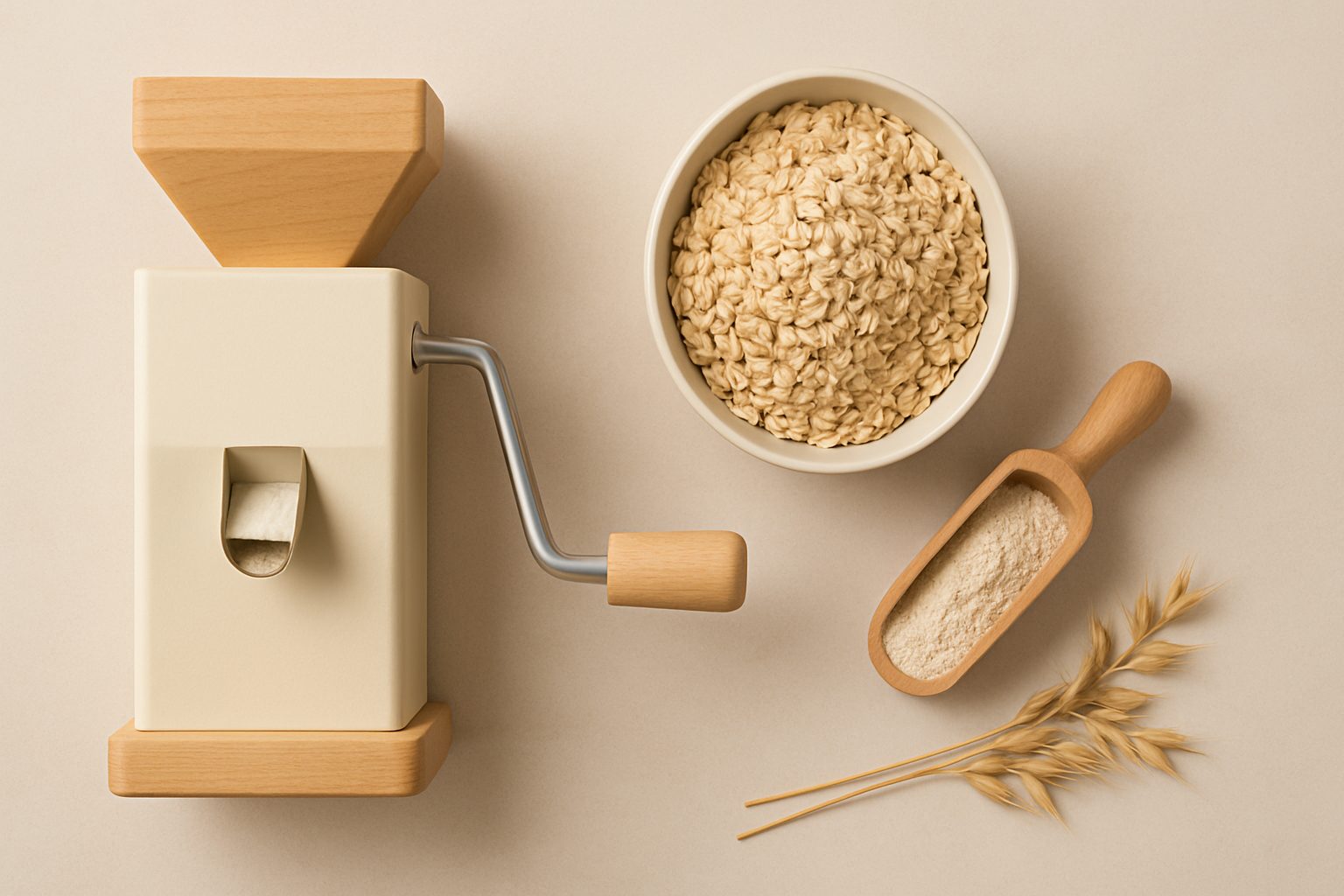
Best Grain Rollers for UK Homesteaders: High-Volume Home Milling
If you're running a homestead that processes grain in volume—whether for animal feed, bread flour, or malt for brewing—a decent grain roller becomes less of a nice-to-have and more of a back-saving necessity. Unlike small tabletop hand-crank models, heavy-duty rollers can handle serious throughput: the difference between spending an afternoon grinding and getting a week's feed done in an hour.
The challenge is finding equipment robust enough for regular use without paying commercial mill prices. UK homesteaders face particular constraints: limited space, import duties on specialised equipment, and the need for machines that handle UK-grown grains reliably.
Why grain rollers matter for bulk processing
A roller crushes grain between two rotating cylinders, flaking it rather than grinding it into flour. This matters because:
- Throughput: A proper roller processes 5–15 kg per minute, depending on the model. Hand mills manage maybe 2 kg per hour.
- Texture control: You get consistent flake size without generating heat that damages nutrition (important if you're processing for livestock or malt).
- Multi-grain capability: Rollers handle barley, oats, wheat, maize, and mixed grains with minimal adjustment.
- Durability: They're built for repeated use under load, not intermittent hobby work.
Hand mills wear faster under heavy use and will frustrate you on day two of processing a tonne of barley.
Key specifications to compare
When sizing a roller for your needs, look for:
Roller gap adjustment: Graduated, easy to fine-tune. You need this to move between coarse flakes (livestock feed) and finer material (baking flour or malt prep). Budget models with fixed gaps are false economy.
Power and speed: Electric models (typically 0.75–2 kW) outpace hand-crank by a huge margin. If you're doing 50+ kg a week, electric pays for itself in labour alone. Roller speed should sit around 200–400 rpm; faster doesn't mean better—it can overheat grain.
Hopper capacity: 5–10 kg reduces feeding interruptions and dust. Larger is not always better; it adds weight and takes floor space.
Build quality: Cast-iron or steel rollers, not aluminium. If the frame flexes, you'll get uneven crushing and fast wear. Check bearing quality—sealed bearings mean less dust ingestion and longer life.
Heavy-duty models worth considering
Osttiroler two-roller mills are Austrian-built and common on larger homesteads across Europe. They're pricey but genuinely durable: many are running twenty years in. Capacity around 50 kg/hour with fine adjustment. Available through specialist farm-supply importers in the UK, though delivery adds cost.
Barley Crusher (US-made, electric conversion kits available): Originally hand-crank, but solid construction. Two hardened steel rollers, straightforward gap adjustment. Around 8–10 kg/hour by hand, much faster with a motor retrofit. Parts availability in the UK is decent—they're popular with home brewers—and the upgrade path is clear if you want to motorise later.
Hawos grain mills with roller attachments: German engineering, compact footprint. The base mills are variable-speed electric (important for grain flaking), and the rollers are reasonably priced add-ons. Better for regular flour production than pure livestock feed, but flexible.
Agricultural supplier models (often rebranded): Rural supply merchants stock simpler two-roller mills rated for 20–40 kg/hour. Less adjustability than premium units, but if you're processing barley and oats at a steady flake size, they're workmanlike and parts are local.
Honest trade-offs
Cost vs throughput: Entry-level electric rollers start around £150–300. A proper grain mill setup (roller + motor + stand) runs £500–1500. Imported premium models double that. Don't buy the cheapest unless you're processing under 20 kg/week; the metal gets fatigued and bearing play increases. You'll replace it in three years.
Space: Even compact rollers need bench or stand space and clearance around them for grain flow. A hopper-fed setup with catch tray takes a 2m × 1m footprint minimum.
Maintenance: Sealed bearings mean less fuss, but rollers do need occasional cleaning (chaff gets in). Electric motors can overheat if you run them continuously without breaks—take it steady if processing large batches.
Grain suitability: Rollers handle clean, dry grain well. Damp grain clogs; very small seeds (like canary seed) slip between rollers. If you're storing grain long-term, you need dry conditions anyway, so this is rarely a real problem.
Getting started
Start by defining your actual throughput. "I want to process my own grain" is vague; "50 kg of barley per week, year-round" is actionable. That tells you whether a hand mill is tolerable or electric is essential.
If you're in a rural area with farm suppliers, visit and see models in use. Someone nearby likely uses one. Talking to them beats any forum thread: they'll tell you what they wish they'd known.
For online sourcing, UK agricultural suppliers and specialist homesteading retailers stock these machines. German and Austrian brands often ship within the EU with reasonable duty now, though delivery times are longer than Amazon.
Don't assume bigger is better. A roller doing 15 kg/hour that you'll actually use beats a 40 kg/hour beast that lives unused because it's temperamental or huge. Grain processing is physically demanding; equipment that's intuitive to use gets used.
A solid two-roller mill, electric-powered, with adjustable gap and decent bearings will serve a homestead through years of regular processing. It's an investment, not a gadget—and if you're milling seriously, it pays itself back in saved time and better feed quality within a season.
More options
- Electric Home Grain Flaker / Roller (Amazon UK)
- Manual Grain Roller for Home Use (Amazon UK)
- KitchenAid / Stand Mixer Grain Roller Attachment (Amazon UK)
- Eschenfelder Grain Flaker (Amazon UK)
- Whole Grain Oats & Wheat Berries (consumable upsell) (Amazon UK)